Blog Archives

RootWork:Using the Folk Magick of the Black America for Love, Money, and Success

Rootwork: Using the Folk Magick of Black America for Love, Money, and Success is a very short and concise book. The author clearly wanted to provide a short and easy to read introduction to the practice of Hoodoo. The author wanted to provide a book where the individuals reading could come away feeling at least on a surface level familiar with the topic of Hoodoo and what Hoodoo was.

The short book covers history, the practice, and provides some simple spells and recipes that a novice could use to start their practice. The book is divided up into three parts. Each of the sections of the book provided insightful information but could have been more in depth.

The first part of the book covers the basics which includes the history and some of the basic cultural influences that have made Hoodoo what it is today. This section also defines what Hoodoo is and how it is different from the religion and spirituality of Voodoo. The section also does a basic introduction into the beliefs behind Hoodoo or Rootwork into why this system works. With any folk magic tradition it is essential to understand the culture and the history of the culture the magic system comes from. Without these understandings the practical aspects of the system become useless and one will never really understand what the system has to provide.

The first chapter in the book covers what Hoodoo is as a practice. This is probably one of the most essential chapters in this book. Here the author illustrates why Hoodoo is actually a different system than voodoo. It is also here that we begin to understand the role that Hoodoo played within the slave communities during the years that the slave trade existed. The author also barely covers how the practice managed to survive and adapt. This is also where we see how important herbs played in the roles of the lives of the African Americans historically.

The second chapter covers the history of Hoodoo. Here we see why the practice basically disappeared thanks to regulations in the US regarding slaves and congregations. This chapter also explains why there are various regional differences in southern and central America as well as within the Caribbean Islands that you will not find in the United States tradition of Hoodoo. This is due to the culture of those regions and how easily the slaves were able to adapt their native practices to that of the practices of the slave owners. The author’s main point in these illustrations is that Hoodoo arose out of the slave trade and it is important that we never forget that Hoodoo was and is the connection African Americans have to their native ancestral tribal practices.

Here the author explains that Hollywood has bee one of the biggest contributors to the misunderstanding of hoodoo as a magical practice rather than a religious practice. It is thanks to Hollywood that Hoodoo is seen as an evil practice rather than a rich system of healing spells and life work. While it is true they had spells and practices to harm others and defend the family, Hoodoo originated as a healing system as the slaves could not afford traditional medical care.

The author also illustrates within the chapter the reasons that a person may practice Hoodoo. Given the origins of the tradition and the terrible history of slavery it is a solid question. The authors answers are simple. The author provides 5 simple reasons that any one of African descent may want to practice or learn Hoodoo. The two reasons I found most inspiring are to connect to your ancestors log dead and for spiritual and personal growth and empowerment.

The third chapter and final portion of part one is about how Hoodoo works. Before going into the basic techniques and practices of Hoodoo one should have a basic understanding of the beliefs associated with this tradition. The six commonly held beliefs of Hoodoo Rootworkers forms the basis of how the tradition works. A perfect way to end the first part of the book.

The second part of the book provides some insight as to what the practice of Hoodoo may entail. This section of the book is aptly titled “Elements of Rootwork”. This section of the book is not meant to be a practicum or how to. This is a section that talks about the practices you will find in the how to section. A few of the techniques and practices have some exercises on how to perform that particular practice or use that skill. Overall the segment of the book was designed to introduce you to the basic skills and practices you may find a Hoodoo or a Rootworker engaging in.

The fourth chapter in this book starts off the elements section. For those who are familiar with European systems of magic you may be surprised to find a chapter on the elements and how the elemental forces of earth, air, fire, and water, are used in Hoodoo. This chapter covers how each element has a specific type of magical act that may be used as well as the properties of that element. The concepts here are new and useful to those coming from a European background looking for other ways they can work with the elemental forces of magic.

The fifth chapter in the book covers talismans and charms. Out of all the practices associated with Hoodoo the practices of talismans and charms is probably the most thought of and common one. Here the author goes into some of the traditional Hoodoo charms and talismans that many people are not familiar with covering the use of herbs as talismans by themselves as well as covering the use of human and animal parts. There is also a section on how to most effectively place the talisman or charm for its effect called “laying a trick”.

The sixth chapter in this book covers spirits of the dead. The chapter begins by discussing the types of spirits of the dead that one can experience and meet. The book then goes on to how to honor them and provides a few different examples on how one can communicate with them.

The last chapter in this section covers the various forms of divination that a Hoodoo practitioner may engage in. There are many different methods of divination. The author here explains why divination is engaged in prior to spell and ritual work. The majority of this chapter covers how to perform divination using simple day to day playing cards.

The final section of the book is the one that I was most eagerly interested as a reader which was the selection of spells and recipes to try. The final section of this book is what brings the book from an informative book about the history, practices, and tradition into a practical handbook.

The eighth chapter of this book focuses on what one needs to know before one can actually practice or use the spells and rituals outlined in the following chapters. This very short chapter is essential as it provides a few guidelines to using the spells effectively.

The remaining three chapters are made up of spells and rituals that are written in a step by step manner making them easy to use. Each of the spells contains a list of materials that are required followed by a list of actions and steps to take. Some of the spells have ingredients or actions mentioned earlier in the elemental magic section, but when combined the spells provide useful tools for creating a basic practice.

To end the author provides a selection of providers for spell and ritual supplies. Combined with the spells earlier and the techniques outlined throughout the book this final touch creates a useful handbook for any one to use. Together with the spells the providers and the authors make Hoodoo accessible in the 21st century to a wider selection of people than ever before.


Why those who seek spiritual connections are always studying

The last few blog entries have been focusing on why pagans and witches are very individual people and why personal truth is so important.  Today is a bit of a continuation on that theme.  Today it’s about why witches and pagans are always seemingly reading a new book or looking for new materials to study,

There is always something new to explore or even something old to reexamine.  With in the realms of spiritual practices and spiritual development there is always something new to learn about.  There are so many different cultures out there that one can always look to new cultures for further inspiration as to where they would like to go or different types of practices.

I’m going to provide a few cultural examples that you can look at to see what I mean when it comes to looking for new things to study and explore to advance your spiritual practices and development.  These are examples of things that I have looked at and thought about for my own personal studies.  Though these will only serve as examples.  From here  I will go back and talk about what exactly this means for you as a seeker and a practitioner.

The first example I am going to cover is that of Germanic Paganism and witchcraft.  These are two spiritual and religious paths that are a part of my personal practice that also inspire and help form the products that this business sells.  This is also a popular culture to explore spiritually right now with more people having interest in Germanic mythology with new pop culture references.

In Germanic paganism there is a lot of lore that can be explored.  Most people start off with the Eddas and Sagas.  With in the Eddas and Sagas there are many tales of magical practices and spiritual works.  This is where most of the concepts of Modern Germanic worship come from such as the Blot and the Sumbel.  The Eddas and Sagas while having an extensive study in themselves, is not the only source of the lore out there.

Many people are familiar with the Grimm’s brothers fairy tales.  These fairy tales actually come from the Germanic forests,  These fairy tales provide another source of wealth for practicing Germanic Paganism and witchcraft.  The tales describe many different spirits and even some of the traditional practices of the Dwarves, Witches, Elves, and other spirits found within Germanic cultures.   These tales provide even further keys into the folk knowledge that create the base of witchcraft and other magical practices.

Aside from the fairytale and the Eddas there are other sources of practical information.  The Rune poems give inspiration for the practice of rune magic which has been mentioned in the Eddas and the Sagas.  By reading the Rune poems a Germanic Pagan begins to study another wealth of information regarding the spiritual practices of the ancient Germanic Pagans.

Even within the Umbrella of Germanic Paganism and practices one could go into even more specific studies.  For example one could focus their attention on the continental practices in old Germany and Norway for example.  Focusing even further on some of those specific tribes.  One person could even focus on the Anglo-Saxon practices (England mostly here for those looking for a region).   One could go so far as to say that even the Icelandic practices and tribal setting would have been different.

While each of these tribes had a base shared language and some base cultural similarities, the names for the Gods and even some of the specific practices were different.  Though they were similar and related enough that the cultures and tribes were able to trade and intermarry and work successfully together in war and in peace.

Those are just a few examples from the Germanic cultures.  There is so much to explore and study within one area of the vast umbrella of Paganism and Pagan spirituality that one will always find something new to learn and study.  Even if a person decides to stick to a specific set of cultural practices and identities ( Germanic paths for example) there will always be something to learn.

Here is a set of examples from a different Pagan culture completely.  Hellenic Paganism or Greek style Paganism has many different facets.  This cultural style of study and practice can be even more difficult and extensive as it is so diverse.  You have on one hand the cults for each city state as well as cults of areas.

Greece because of the way it was organized for many years did not have really a cohesive religion for the culture.  They had in general a pantheon that they all shared with some common festivals, but each area was highly specific.  There were areas where people focused their entire worship on One of the Gods and you had those whose temples were only really visited once a year (The Elysian mysteries for example).

Hellenic pagans from what I have found typically follow one or two specific Gods that are their Patron Gods. While extensive research into the practices of worship in the culture is important in order to form bonds closer to their chosen deities they will most likely focus their attention on studying the cult centers and cult worship of those Gods.

The above examples were specific to Paganism in general as a study.  Now I am going to try and give some examples of magical practices from the view of a witch who is always studying and learning.  This blog does focus on all of these topics so covering both of these topics in this entry is reasonable.

Within magic and witchcraft there are many different ways to practice and types of practices that one can study.  To be honest there are so many options that a newbie often seeking to start practicing witchcraft can feel overwhelmed.  Which is why many find that mastering spellcraft can be near impossible and they wonder if they are doing it right.

In magic you have herbalism, crystal and gem magic, Galdar, Seidr, Trance work, summoning, healing work, poppet magic, astral projection, weather work, ect.  Often times a person may have so many interests that they can’t figure out where to start and will find that practices can overlap.

I’ll take Herbalism for example.  In Herbalism a witch and magician studies the herbs that they work with.  They can use them in powders and in potions as well as in oils, lotions, tinctures, soaps, and other types of charms.  There is also the healing work with herbalism.  Though while one studies making an oil for example they may learn or hear about spell oils from Hoodoo and then start to explore that for further herbal use and practices.

The examples above are one cultures examples of how deep and diverse the study of a cultures religious heritage can be.  The above examples also illustrate just one example of why it is impossible to master the spiritual crafts.  There will always be something new to learn and explore.

This is also why some witches, Pagans, and spiritual people tend to have rather extensive libraries.  Books are used as references in work and in studies and are often to valuable to just borrow from a library when it is needed.


Witchcraft-A craft and a Practice

Today there is more of a trend in witchcraft towards making all of witchcraft religious.  This is simply not the case.  Witchcraft is a practice and a craft.  The world craft is in the word witchcraft which implies that there is a skill and a practice to witchcraft.

While there are many ways that witchcraft can be a part of a religion like Wicca, Witchcraft is not a religion.  It is a craft and a practice.  It has a philosophy and a spiritual background but in the end witchcraft is a practice and a craft.

There are no actual specific rites or beliefs held and practiced by all witches.  Which is why witchcraft is not a religion.  There are no united beliefs and practices among witches aside from the belief in magic and the practice of magical arts and even that can be debated as a non issue as many witches don’t believe in magic-they know it exists and work with it.

Every witch is different and has their own practice.    Some witches will practice more intense ceremonial magic with elaborate altars and spirit invocations while another will practice more simple folk magic and remedies.  Some witches will work shamanic rites while any other witch may practice meditative rites and do everything in their mind.
While the belief in spiritual powers is common not all witches will work with all of them.  Witches have the power to contact and summon spirits who work with them as their aid and partners.

There are religious practices of witchcraft but that does not make witchcraft a religion.  For myself nature worship or a nature based spirituality would be my religion while witchcraft is my practice.  The Gods and spirits I worship are deities and spirits associated with witchcraft so I consider my religion a witchcraft religion.

Being a witch does not mean you practice a religion like Wicca.  Being a witch merely means you practice some form of witchcraft.  Invocations to Gods and spirits are not required in spells nor rituals.  Being a witch is simply working with the forces of nature and the universe to create changes in this world.

~Loona Wynd~ )0(

Know your craft

It is important to know your craft as a witch, pagan, or spiritual practitioner. One does not simply know their craft through books and study. One must practice and explore their craft in order to really know their craft.

It is often said that Witches dont believe. That they know. This is because they have experienced magic and spells. They have done the rituals and done the book study. Putting them together one gains knowledge and wisdom.

So how does one get to know their craft and path?  One must gain experiences.  By trying new techniques that are read about in books one gains new experiences.  By performing exercises over and over one can gain deeper understanding of the topics they are exploring.  This gains knowledge.

There is an academic study involved in the development of knowledge.  This involves history and cultural studies.  It involved studying mythology and folklore.  It then involves studying practical modern books as well.  From here we gain exercises and techniques to try.

The important thing is that one must actively practice their craft in order to really know the craft they practice.  The practices give us experiences.  These experiences are what give us the potential to access and experience the various types of mysteries mentioned in a earlier post.

Witches experience their craft.  Pagans experience their deities in ritual and in trance.  Shamans experience the spirits that they work with and fight.  Magicians know the magical forces they work with.  Here you could say that experience turns belief into knowledge and inner truths.  In the end this is what it means to really know the truth and the crafts that we practice.

Some witches will choose to practice certain crafts more than others.  Every witch must find their own practice and style of working their craft.  There are never two witches who will practice the same thing.  We must develop our own practices based on our own experiences and tastes.

Knowing our craft comes through study, exploration, testing, failures, and much more.  This takes time and effort but it is worth it.  Find what areas and styles of witchcraft really catch your fancy and drive you “wild”.  Ignite your passions and find your craft.  Create it and craft it.  Learn it and study it make it yours and claim the knowledge for yourself.

~Loona Wynd~)0(

Witches and Personal Truth and Myteries

Religious witchcraft falls under the category of mystery religions.  In mystery religions the focus is not on worshiping the Gods through action and words but on having direct experiences with the Gods and the spirits.  Mystery religions are all about bringing forth the Gods from within you and becoming one with them.

Mystery religions are not religions of the book.  In a mystery religion it is not so much important on how the religion is practiced.  This is actually  a type of religion which is based on experience.  The lore and the rites of the religions are there to guide and direct you towards your interactions with the Gods and spirits and may even provide some context for the meetings.

The nature of these religions means that it is impossible for each witch or participant to ever have the exact same experience.  Even covens of traditional Wiccan practices like Gardnerian or Alexandriean while there is a core set of contexts and practices which provide a foundation for some what shared experiences, in the end each of the members of the covens have their own relationships and their own unique experiences.

Mystery religions can not be learned from a book.  With this statement one may be wondering why there are so many books out there on the market on witchcraft and pagan practices.  The answer is simple. The books provide key concepts and guidelines which can lead the seeker to having their own experiences.  With the books and the concepts within the books a witch is able to begin their understanding and practices for developing their own spiritual path.

This is ultimately the reason why two witches will never practice the same path even within the same tradition or base practice.  Each with must find their own way.  No one path is better than the other paths out there.  It is simply not the path for you.  Even if a path is not perfect for you there may be something in that path that will inspire you or have something to teach you.

Be open and let the spirits teach you.  Find your own wisdom and personal path.  Let your heart guide you and your path can do no wrong.  Go out there and experience life and what the spirits has to offer.  Play and go wild.  Don’t let other people tell you what to do.  This is your path and your journey.  Find your own truths and find your spirituality.

~Loona Wynd~)0(

Witchcraft not all light and love

Simple Daily Spell

One thing that many starting Pagans, witches, and magicians seek to do is find a way to  integrates their spells and rituals into their daily life and really make it a part of who they are.  When I started out in my studies and practice of witchcraft this was one thing that I too struggled with.

Here is a simple spell and ritual that you can use every morning to refresh yourself and prepare for a new day.

Materials:
SoapWater
Shampoo & Conditioner

When you get into the shower turn the water on to as hot as you can stand.

Get in the shower and let the water rinse you off.  A the water rinses your body before you soap state:

“Water water wash away
Water water cleanse today”.

Take your shampoo and soap and wash your body once.  Repeat the chant over and over again.  As you watch the soap go down the drain visulize all emotional baggage that causes you pain washing down the drain as well.

Soap yourself up and repeat the chant and ritual once more.  This time see any and all blocks in your way going down the drain.

You may shorten the chant to “wash a way cleanse today” as you get into the washing.

Use this each more to prepare for each day,

Enjoy!

Loona Wynd

Pagan Pride day events- why we should attend

Magic-The creative and destructive forces of the universe

Magic is a powerful force.  This is the force that allows witches and other magical traditions and practices to be able to cause the great changes they do in the world.  This is a force that is neutral in nature.  This is a force that is used to both create and to destroy.  It is the same force used to heal and to bless that is used to harm and to curse.

By itself magic has little to no direction.  Magic as a force will simply work to cause changes in the lives of the world.  That is what magic is.  Magic is the subtle forces that effect changes.  These are the forces caused by thoughts and actions as well as emotions.  The energy which makes up magic is the very energy of life which is why thoughts and emotions are key to the way magic works and acts.

There are many different names for people who practice magical arts.  Witches are one.  Shamans practice a form of magic as do many other tribal Wisemen and women.  One thing that unites magic practitioners is some form of mental discipline and training.  This training is what allows them to connect to the creative forces of the universe however they envision them.

It was mentioned above that thoughts and emotions are key to manifesting and making magic work.  It was also mentioned that those who practice magic are often trained with some form of mental discipline.  These two statements illustrate the reason why magic is both creative and destructive.  Human thoughts and emotions are creative and destructive,  This is also why with out direction and manipulation magic is simply a neutral force that creates changes in life.

When a person works a spell it is the intent behind the spell that gives form and direction to magic.  Intent is made up of thought and emotions.   The actions performed during spells and magical ritual are items used to focus and intensify concentration on desires- the intent of the spell.   The desire or intent has an emotional basis.  The stronger the emotion the more powerful the spell or ritual action will be,

The energy raised in the spell has direction.  It has purpose.  In order to allow the spell to work the magic will destroy some options and possibilities and create another.  This is why magic as a tool and as a practice is always creating and destroying.  It is a force that causes changes.   This is the force of the cosmos.

For something to be created something else must be destroyed.  This is a truth of nature.  This is a truth of the cosmos.  New planets and stars are created out of the debris of older planets and stars.  This is also the true meaning of what they mean when they say that matter can never be created or destroyed-merely changes form.

Magic is part of the universe.  It is the force which allows things to be created.  It is creation and destruction.  It is that which allows the universe to continue in expansion.

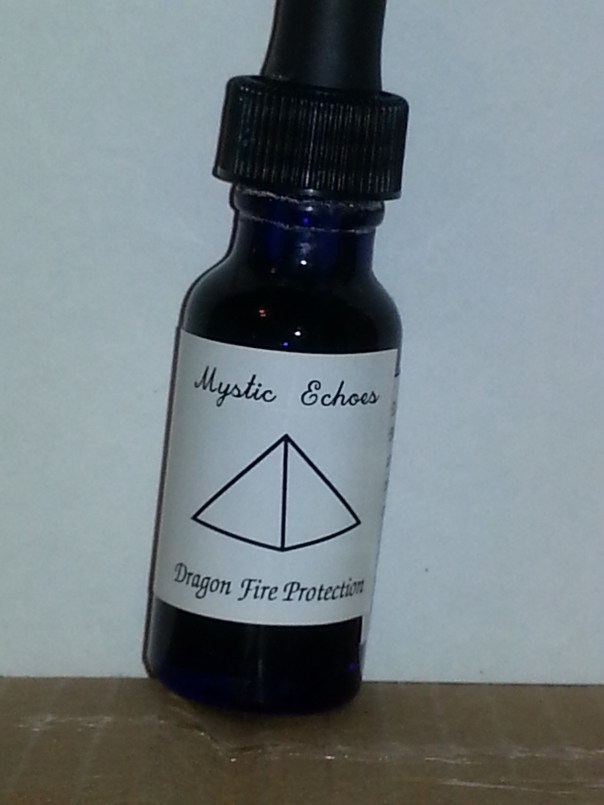
Dragon Fire protection Tincture

This is the Dragon Fire protection tincture.  This tincture was crafted to aid in protection spells and ritual.   This tincture was made out of an infusion of Dragonsblood, White Sage, Frankincense, Ethyl Alcohol

Use this as you would any oil.   It can be used to anoint candles, as perfumes, and as smokeless incense blends.

To buy:  https://www.etsy.com/listing/161383786/dragon-fire-protection-tincture