Blog Archives
Incenses and Magical Powders by Mystic Echoes
The following packets are magical powders that also work as incenses crafted and sold by Mystic Echoes.
Magical powders can be applied in many different ways. You can sprinkle magical powders in the area of the effect (such as around the home for protection or around your business for money and succsess). You can add them to baths and washes and apply them to the body when they are infused with water. You can also carry them in sachets.
The powders by Mystic Echoes are unique. These powders can also be used as incenses. You can burn the loose herbal powders on a charcoal block and let the elements of fire and air activate the spell. You can also with this attribute combine the sachets, sprinkling, baths, and incense all into one super charged ritual!
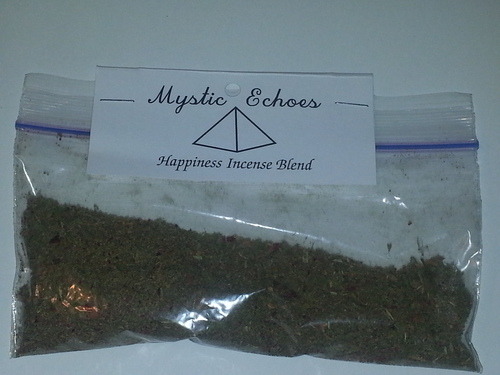
https://www.etsy.com/listing/165798767/happiness-incense-blend?ref=related-5
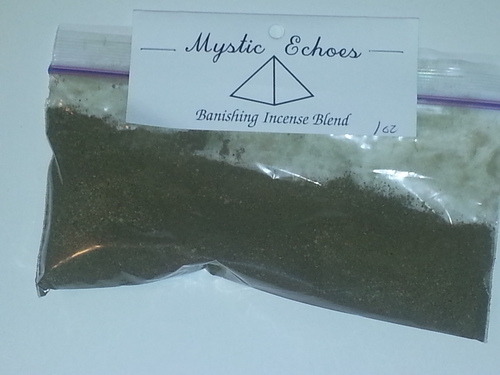
https://www.etsy.com/listing/165797535/banishing-incense-blend?ref=related-6
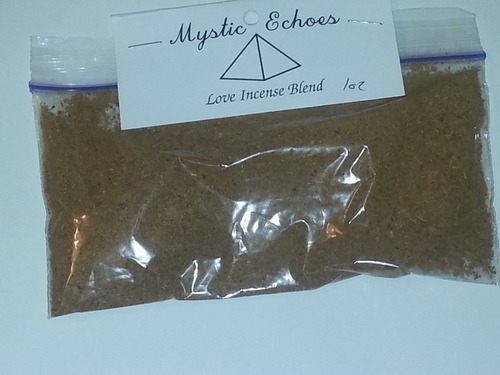
https://www.etsy.com/listing/165800097/love-incense-blend?ref=related-5
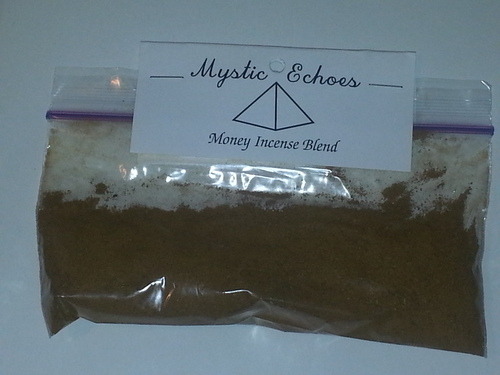
https://www.etsy.com/listing/165801801/money-incense-blend?ref=related-2
Review: The Conjure workbook by Mama Starr

The Conjure Workbook Volume 1: Working the Root is an excellent tome on Southern Conjure work. When I picked up this tome I knew that it was going to be full of Christian mysticism and biblical references. That is what Hoodoo and conjure is. The Southern Hoodoo and conjure traditions are a mixture of folk beliefs from pre-slave days in Africa and the various Christian faiths in the south. This was how the slaves were able to hold on to a bit of their previous culture and identity.
If those who are looking to learn about Hoodoo and conjure work are expecting information to come from a pagan perspective and are looking at this work they will be disappointed. Mama Starr is very clear about her roots and the roots of Southern Conjure which are in Christian belief systems of the south. While she does say that you can be of any belief system and still work the spells and rituals she provides, unless you respect the Bible and understand that it is filled with lore, spells, and practices you will not get anything out of this book.
The author begins the book by discussing the work of ancestors. Here the author begins explaining one of the core concepts and beliefs across Conjure/Hoodoo/Rootwork traditions. There is an overall belief in an existence of an afterlife and that our ancestors will be there to answer us. The author starts by describing how they help us and work with us and finally ends with setting up an altar to venerate and pray to your ancestors.
I mentioned the importance of respect for the Bible as a sacred text and as a book of power as that is the second topic discussed in the book. As I said early on the author is clear in that this book is a southern conjure book which is going to have referenced to the Bible in there. Most of the references are in the Old Testament but they are still Bible references.
After working with the ancestors is covered, crafting altars and work spaces is discussed, and the Bible is mentioned as an important source the Author gets into the spirits and beings that are often worked with in her practice of Hoodoo. Prior to reading this book I was aware of the work with the archangels and the saints. Here I learned of new spirits and beings also associated with Conjure as well as how we can even work with the prophets in the bible.
Each being mentioned came with several different prayers and ways that you can work with them. These early workings are here to give you an idea about the powers each spirit has. These workings also introduce you to the concepts of repeating works, and how actual effort is put into the work. The author makes it clear that these things are repeated several times for effectiveness.
As the book continues the author mentions and focuses on another core belief in rootworking traditions. That belief and practice is one of divination. Starr provides many different ways of working divination including a very traditional practice of reading the bones. While the actual practice of bone reading is not discussed, the author does include its history of use. The author included a photo of her own bone set.
As the book continues the author continues an easy to follow step by step instruction on workings. The author also continues her straight talk. The author is very serious about their work and their tradition. Throughout the book the author mentions how some of these works are dangerous and are not to be simply played with. She does this not to discourage people from doing these works, but to encourage people to take the work seriously.
The author does speak only of their own tradition and practices. While the author does give you all the information you need to create your own Hoodoo/Conjure practice she does encourage you to find an actual teacher to learn more complex works. As an example the author explains why some packet spells written by other authors aren’t as effective as they could be because of folding the paper of the packet in a different manner than she was taught with an explanation of why the other method may actually backfire.
This book is filled with practical information. With the authors attitude, explanations, and the step by step processes in the book the tome The Conjure Workbook volume 1: Working the Root provides everything you need to know in order to effective start working your own spells and rituals. By working the spells in the book you develop understanding of associations and correspondences which can be useful in creating your own effective spells.
Pagan Blog Project: C is for Crafting Protection Salt
Witchcraft is a craft and a practice. As a witch I spend a lot of time crafting different incenses for rituals and for spells. I also spend time crafting spells and rituals. There are many different types of items that can be crafted and built. Today we are going to talk about an item I call protection salt.
Protection salt is in some ways related to Black Salt. The idea behind protection salt is that it will protect your house and home as well as defend your home. Protection salt works both to keep spirits and negative forces away but it also works to cause harm to those spirits and forces that would wish you harm.
Protection salt is really easy to craft and it is very effective. There are very few items used in the recipe and it takes little to no time to craft the items yourself. It takes little to no time and is one of the most effective items I have crafted in recent history.
Materials:
Blender/grinder
Bottle or container
Sea salt 9 table spoons
Dragons blood 3 table spoons
Nettle leaf 3 table spoons
White sage 3 table spoons
Dragon Fire protection tincture 1 1/2 table spoons
Wand or athame to stir
Process:
Measure out the sea salt. Put the sea salt in the grinder
Measure out the Nettle leaf. Add it to the grinder. Mix with your wand or athame
Add the white sage and mix with your wand or athame.
Add the last dry herb (the dragons blood) and mix with the wand or the athame.
Cover the grinder/blender and mix them into a fine powder.
Stir the mixture with your wand or athame.
Call upon the arch angel Michel and the dragons of protection to fill the salt with their power.
Direct Michel power and the dragons power into the salt mixture. Blend with your athame or wand.
Finally add in the Dragons Fire tincture. Feel even more Dragon energy and sacred protection energy filling the blender.
Once more blend the mixture.
As it blends focus on protection and defense of your home, office, or even car. See the mixture radiating both protective and defensive energy.
Bottle the mixture in a bottle or container and label it.
Use:
Sprinkle the mixture on all the windowsills and under all the doors in your home. Sprinkle the mixture on the floors in every room, on your porch, on your steps, and in your drive way. This seals the protection around the building and within the building.
The tinctures addition to the mixture allows the salt to stick better to the windowsills, doors and steps.
Items mentioned:
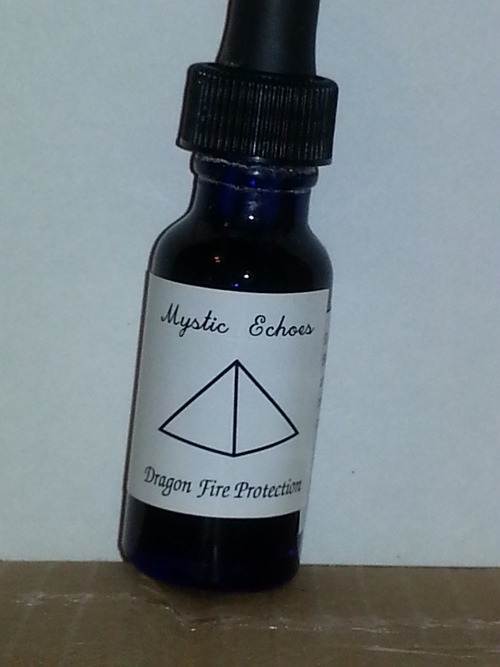
Available: https://www.etsy.com/listing/161383786/dragon-fire-protection-tincture?ref=shop_home_feat_2
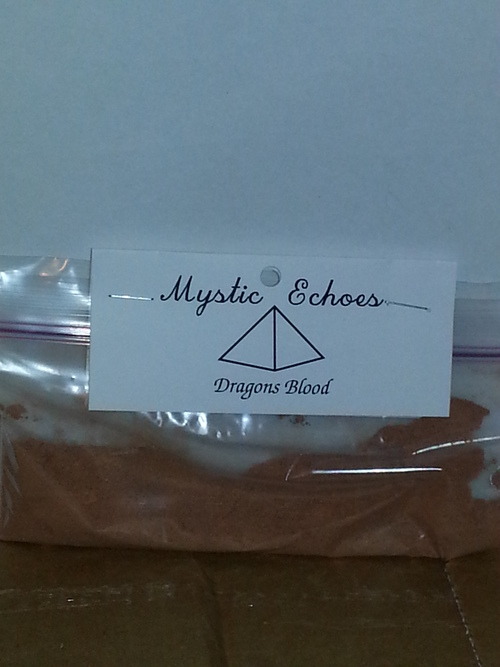
Available: https://www.etsy.com/listing/163604756/powdered-dragons-blood-resin?ref=shop_home_active_11
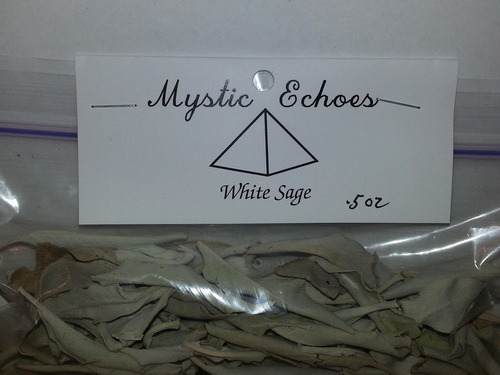
Available: https://www.etsy.com/listing/161392601/white-sage?
Good luck on crafting your own Protection Salt. If you have any questions feel free to ask me. I will more than gladly help you understand why I used the items I used and how they work as a combination,
RootWork:Using the Folk Magick of the Black America for Love, Money, and Success

Rootwork: Using the Folk Magick of Black America for Love, Money, and Success is a very short and concise book. The author clearly wanted to provide a short and easy to read introduction to the practice of Hoodoo. The author wanted to provide a book where the individuals reading could come away feeling at least on a surface level familiar with the topic of Hoodoo and what Hoodoo was.
The short book covers history, the practice, and provides some simple spells and recipes that a novice could use to start their practice. The book is divided up into three parts. Each of the sections of the book provided insightful information but could have been more in depth.
The first part of the book covers the basics which includes the history and some of the basic cultural influences that have made Hoodoo what it is today. This section also defines what Hoodoo is and how it is different from the religion and spirituality of Voodoo. The section also does a basic introduction into the beliefs behind Hoodoo or Rootwork into why this system works. With any folk magic tradition it is essential to understand the culture and the history of the culture the magic system comes from. Without these understandings the practical aspects of the system become useless and one will never really understand what the system has to provide.
The first chapter in the book covers what Hoodoo is as a practice. This is probably one of the most essential chapters in this book. Here the author illustrates why Hoodoo is actually a different system than voodoo. It is also here that we begin to understand the role that Hoodoo played within the slave communities during the years that the slave trade existed. The author also barely covers how the practice managed to survive and adapt. This is also where we see how important herbs played in the roles of the lives of the African Americans historically.
The second chapter covers the history of Hoodoo. Here we see why the practice basically disappeared thanks to regulations in the US regarding slaves and congregations. This chapter also explains why there are various regional differences in southern and central America as well as within the Caribbean Islands that you will not find in the United States tradition of Hoodoo. This is due to the culture of those regions and how easily the slaves were able to adapt their native practices to that of the practices of the slave owners. The author’s main point in these illustrations is that Hoodoo arose out of the slave trade and it is important that we never forget that Hoodoo was and is the connection African Americans have to their native ancestral tribal practices.
Here the author explains that Hollywood has bee one of the biggest contributors to the misunderstanding of hoodoo as a magical practice rather than a religious practice. It is thanks to Hollywood that Hoodoo is seen as an evil practice rather than a rich system of healing spells and life work. While it is true they had spells and practices to harm others and defend the family, Hoodoo originated as a healing system as the slaves could not afford traditional medical care.
The author also illustrates within the chapter the reasons that a person may practice Hoodoo. Given the origins of the tradition and the terrible history of slavery it is a solid question. The authors answers are simple. The author provides 5 simple reasons that any one of African descent may want to practice or learn Hoodoo. The two reasons I found most inspiring are to connect to your ancestors log dead and for spiritual and personal growth and empowerment.
The third chapter and final portion of part one is about how Hoodoo works. Before going into the basic techniques and practices of Hoodoo one should have a basic understanding of the beliefs associated with this tradition. The six commonly held beliefs of Hoodoo Rootworkers forms the basis of how the tradition works. A perfect way to end the first part of the book.
The second part of the book provides some insight as to what the practice of Hoodoo may entail. This section of the book is aptly titled “Elements of Rootwork”. This section of the book is not meant to be a practicum or how to. This is a section that talks about the practices you will find in the how to section. A few of the techniques and practices have some exercises on how to perform that particular practice or use that skill. Overall the segment of the book was designed to introduce you to the basic skills and practices you may find a Hoodoo or a Rootworker engaging in.
The fourth chapter in this book starts off the elements section. For those who are familiar with European systems of magic you may be surprised to find a chapter on the elements and how the elemental forces of earth, air, fire, and water, are used in Hoodoo. This chapter covers how each element has a specific type of magical act that may be used as well as the properties of that element. The concepts here are new and useful to those coming from a European background looking for other ways they can work with the elemental forces of magic.
The fifth chapter in the book covers talismans and charms. Out of all the practices associated with Hoodoo the practices of talismans and charms is probably the most thought of and common one. Here the author goes into some of the traditional Hoodoo charms and talismans that many people are not familiar with covering the use of herbs as talismans by themselves as well as covering the use of human and animal parts. There is also a section on how to most effectively place the talisman or charm for its effect called “laying a trick”.
The sixth chapter in this book covers spirits of the dead. The chapter begins by discussing the types of spirits of the dead that one can experience and meet. The book then goes on to how to honor them and provides a few different examples on how one can communicate with them.
The last chapter in this section covers the various forms of divination that a Hoodoo practitioner may engage in. There are many different methods of divination. The author here explains why divination is engaged in prior to spell and ritual work. The majority of this chapter covers how to perform divination using simple day to day playing cards.
The final section of the book is the one that I was most eagerly interested as a reader which was the selection of spells and recipes to try. The final section of this book is what brings the book from an informative book about the history, practices, and tradition into a practical handbook.
The eighth chapter of this book focuses on what one needs to know before one can actually practice or use the spells and rituals outlined in the following chapters. This very short chapter is essential as it provides a few guidelines to using the spells effectively.
The remaining three chapters are made up of spells and rituals that are written in a step by step manner making them easy to use. Each of the spells contains a list of materials that are required followed by a list of actions and steps to take. Some of the spells have ingredients or actions mentioned earlier in the elemental magic section, but when combined the spells provide useful tools for creating a basic practice.
To end the author provides a selection of providers for spell and ritual supplies. Combined with the spells earlier and the techniques outlined throughout the book this final touch creates a useful handbook for any one to use. Together with the spells the providers and the authors make Hoodoo accessible in the 21st century to a wider selection of people than ever before.
Forging Pentalism
So what gives about the blogs name? Forging the Pentacle?
The explanation is simple. The path I have started to develop is called Pentalism. There are five aspects to almost all parts of the practice. There are five primary influences, five Gods, Five goddesses, five parts of the soul, and more. The pentacle for me shows how while there can be five individual points, in the end they can all be connected and are always interwoven in peace. The Pentacle is an extremely sacred symbol for this path due to the importance of five. Pentalism is meant to be experienced in a group setting. However I have not really developed each of the degrees and practices (related to each of the foundational traditions of types of craft) I can’t really teach and initiate people until the first degree has been formed (I’ll develop the second degree material in my personal practice as I teach the first degree and so forth).
Ok, so that explains the name, what about content?
I already mentioned some of the content you will be seeing. There will be information on ritual content as well as some basic sabbat or holiday information. There will be some basic information about the deities involved (this is going to be an initiatory oath bound tradition). There will also be posts about failures and successes and everything in between. When I fail I want to have people laugh at it and also help me find out where I went wrong.
By writing this blog I am sharing the basic outline of what will become my tradition. I process information best when I write out my thoughts and my experiences. By putting the information and the process on a blog I hope to get input from other people in the Pagan community . I want that input to challenge me. I want people to point out mistakes in my research and logic. I also want people to tell me why they like something or find something useful. That way I can become a better writer and explore the things I write about in a different light.
This blog will also be participating in the Pagan Blog project. However all of the entries on this blog will reflect this path specifically and only this path. My other blog (Seeker sight) is more about my search for knowledge and wisdom which I can find any where. There will be some cross over as they both will cover some of the same beliefs and practices. That said both blogs should be treated as unique and individual blogs.
You said the title is “Forging the Pentacle” right? So what are your tools and what are the foundations and origins of Pentalism?
There are five primary spiritual and religious practices which form the basis of Pentalism. All of them are different forms of witchcraft as a spiritual practice. Each of them has provided me with many different ways of working my craft and my religion. They have all had an effect on how I have experienced the Gods and Goddesses of Pentalism. I don’t belong to any one of these practices, but have combined them all. Which is why I am and Pentalism will always remain an eclectic religious witchcraft tradition.
The first witchcraft path I must discuss is Wicca. When I say Wicca I don’t mean the works of Silver Raven Wolf, Edain Mc Coy, D.J. Conway, Raymond Buckland, or even Scott Cunningham to name a few. I am refering to the books by Janet and Stewart Farrar (What Witches Do, 8 Sabbats for Witches, Way of the Witches, The Witches God, The Witches Goddess), Gerald Gardner (Witchcraft Today and The meaning of Witchcraft), and some of Doreen Valientines work as well as the writings of Alex and Maxine Sanders. Those are actual Wiccan initiates who have lineage via initiation which is cross gender and that can be traces back through Gerald Gardner to the New Forest coven of witchcraft.
A brief explanation of how I define Wicca is required here. I define Wicca as an Oathbound, Mystery, Cross Gender initiatory, Orthapraxic Witchcult where every initiate is a member of the clergy That is a lot to swollow. So I am going to break it down into little bits. I’ll cover each section in it’s own paragraph. Once you’ read each paragraph you’ll see why that simple definition required extra explanation. You’ll also see why I have such a strict view on Wicca and why I am only Wiccan influenced and Inspiried.
Let’s start with the term “oath bound”. By oath bound I mean that the rites and rituals, mysteries, names of deities, and practices are known and only taught to initiates after initiation. Prior to initiation the rites and rituals a seeker and pre-initiate experience are Wiccan flavored and Inspired, but Not Wiccan. There are many religions whose practices are oath bound. In history the Eluisian mysteries come to mind as only the members of that cult ever experienced those rituals and knew what those rituals entailed. There you go. A historical reference to a religious practice and set of mysteries that are oath bound.
The next term in my definition is mystery oriented or based. So what does this mean? By Mystery I mean that there are some aspects of the religion that are based on expereince in ritual which are deeply intimate and can not truly be expressed by words. All witchcraft traditions have mysteries.
The Cross Gender initiation is self explanatory. Only men can initiate women and women can only initiate men. This goes into the power myth described in the decent of the Goddess. There is also an issue of polarity. I’m sure all the reasons for this practice are explained after initiation. It’s something I have experienced. The “public” rite I went to basically said that in their circles it’s male-female-male-female as much as possible (based on the ration of men to women). I actually think it’s a great way to raise energy.
The orthapraxic aspect of Wicca is something that many people can’t grasp coming from orthodox religions such as Christianity where having specific beliefs was the important part of the religion. In Wicca it is not the belief that is important rather it is the proper practice and performance of Wiccan rites and rituals (which can only be performed in a coven setting) that is important. It is the proper performance of these rites and rituals that allow the clergy
The witchcult aspect is important to note as well. Upon the seeker or dedicant’s initiation into Wicca they are made a witch. This is especially important if that person never identified or used that term before. All wiccans are witches, but not all witches are Wiccan. In fact most witches are not Wiccan. Wiccans are witches because they use witchcraft in both practical day to day life and in their worship of their deities. That is what makes them witches.
The final aspect of my definition of Wicca is that they are all members of the clergy. That is right. Once you have been initiated into Wicca you have become a priest or priestess of the Lord and Lady. For this reason every one is a part of the clergy. If you are not called to serve the Lord and Lady of the Isles (the two specific deities in Wicca) then you are not a proper person for Wicca.
Ok. So you explained what Wicca is. You didn’t explain why you say you are inspired by Wicca. Can we get an explanation for that please? Afterall you even said that you aren’t an initiate. There for you don’t actually know the rites and rituals of Wicca. So how are you influenced and inspired by Wicca?
There are a few reasons why I say that. The first thing is that I cleanse ad consecrate my holy water in the same fashion, often times using the same words outlined in 8 sabbats for witches. The second thing is that part of my understanding of the deities I work with (with in Pentalism) was influenced by the Oak and Holy King battles (also described in 8 sabbats for witches). Finally there is the full ceremonial outline. When a full complex ritual is performed it often includes all the elements described within Wicca. These form the first foundation of Pentalism.
The largest element found within my path is the central fact that this path is eclectic. Generic eclectic-neo pagan witchcraft can be found in many different books. My favorites include Christopher Penczak, Laurie Cabot, Ellen Dugan, and Doreen Valientine. I have however also been influenced by Starhawk, Silver Ravenwolf, Edain McCoy, D.J. Conway, Raymond Buckland, and Scott Cunningham (you see there was a reason I mentioned them before). All of these author claim to teach eclectic Wicca. There is no such thing (as shown above). There is however essentially a core tradition of eclectic neo-pagan witchcraft loosely based on Wicca and ceremonial magic as outlined by Cunningham in his book “Solitary Wicca” and “Living Wicca”. At the end of his life he did drop the association with Wicca and simply called it a witchcraft tradition, but the publisher kept the title as is.
The books by these authors all have different views of the God and Goddess and the wheel of the year. However there are some key and central similarities in the practices that lead me to believe they are essentially practicing the same religion, but not always the same way. It is a witchcraft tradition or set of traditions and way of thinking/practicing that has it’s own mysteries and basically a freelance style of ritual. Every eclectic is different, but they are all the same at the same time. We embrace the similarities and celebrate the differences. That is what being a true eclectic is all about.
The MMC concept here is one of the reasons I came to the 5 god and goddess concept for this tradition. It seemed with in the various discussions about the forms of the Goddess with in the wheel of the year there were some things described which never seemed to fit to the MMC concept. I started to see five different Gods and Goddesses described with in the lore and the rituals. That, along with the outline in Wicca lead me to the format that became the Gods and Goddesses of Pentalism.
The ideas about experimentation and the different types of ritual and altar set ups encountered through these books gave me the foundation of how to explore and experiment. That is what has lead me to know what does and doesn’t work for me in my religion and spirituality. That is how I have been able to begin to piece together this tradition. I am very thankful to be an eclectic and to have started to form a cohesive eclectic tradition that I am going to be proud to pass on to others.
Hedge witchcraft is a practice of witchcraft that not many people are aware of. While there are more books available on the subject these days, originally there were only a few websites out there that had any information out there. I am not entirely a hedge witch, but I do embrace and participate in the practices. I say I am not a hedge witch because it is not the only practice I engage in for my craft. While it has played a central role in my access to mysteries, it is not the only or the central aspect of my practice.
So what is hedge witchcraft? Hedge witchcraft is based on the concept of the hedge representing the border between the civilized world (towns, farms, and cities) from the wild (forests, open fields and stretches of road where no one is in sight) and the practitioner being able to be in both this world (civilized) and the other worlds (wilderness and forests). This is the European native form of shamanism.
One thing about hedge witches and hedge witchcraft it is essentially a solitary practice as each hedge rider must find there own way of getting into those trance states, and they need to find their own connection to deities and the sabbats. The other thing is that often time hedge witches will celebrate the sabbats through their trances. This is where the myth of the flying to the witches sabbat comes from. I haven’t used trance as a sabbat celebration yet, but I bet it would be powerful.
However due to my use of various types of trance and trance states to acces the mysteries and to contact spirits I have to add this as one of the foundations of Pentalism. It has been a major part of my practice for years. In fact it was during a workshop on “shamanic witchcraft” that I met my first formal teacher Christopher Penczak. That is also one of the reasons I consider hedge witchcraft to be one of the points on the foundation of Pentalism.
In many ways it has been equated to traditional witchcraft in it’s truest form, but I personally think there are other things. This goes into traditional witchcraft. I had mentioned it in my foundational forms, so I will discuss it briefly here. This is an aspect of the foundation I am still developing. It is a new addition to my practice, and as such it is something that needs a lot of exploration.
So what is traditional witchcraft? I thought that Wicca was a form of traditional witchcraft? Am I wrong?
There are many definitions of traditional witchcraft. The most common definition is that of “forms of pre Gardnerian witchcraft”. By default that makes Wicca not traditional witchcraft, and there are a few reasons for this. Wicca is a more ceremonial form of witchcraft than most traditional witchcraft practices. That is the first and primary difference between Wicca and traditional witchcraft. The other is more of a focus on a personal relationship with the land. While there are some correlations and the like, there are many differences between them. I have explained why Wicca is not traditional witchcraft, but I haven’t explained what it is yet. So here goes.
For me traditional witchcraft is pre-gardnerian forms of witchcraft. There are some forms of this practice which are initiatory (The new Forest Coven for example) and there are many forms which are solitary. The sources I have read on the subject come from both solitary and coven based books. So my view has a bit of both. That still doesn’t explain what exactly traditional witchcraft entails.
Well it is an underworld tradition. The rites and rituals typically involve some sort of physical and spiritual travel which symbolically and spiritually bring us to the underworld. That is where the Gods reside in this tradition. It is also where fate is woven and where the ancestors reside. That is why I say traditional witchcraft is an underworld tradition.
Traditional witchcraft also involves a lot of ancestral worship and veneration. Who and what the ancestors are and what the ancestral worship and veneration mean will be covered in another post shortly. For now they are those who have passed beyond the physical veil and into the underworld reals and they are those who are yet waiting to come back and return (they will be future witches and will create future ancestors). The ancestors are of blood and body as well as emotional and spiritual ties.
The final difference between traditional witchcraft and Wicca is the way the rites are performed and the tools used in rituals. The rituals in traditional witchcraft are less formal and theatrical/scripted. They are more spontaneous, yet they have some structure. All of these are factors in why this form of witchcraft has become part of the spiritual foundation that is Pentalism.
The final point in the Pentalist foundation is that of Hermetic witchcraft. This is a style of witchcraft in religious and spiritual terms as well as magical practices that highly engages the mind. When the tradition will be taught this will actually be the first degree. The points and lessons of this degree are outlined in the book “The Kybalion”. There will be many more essays on the Kybalion and how it relates to this tradition.
The is also tied into the first degree of the Temple tradition. That is where I have started my official training as a witch. For the last three years my magical practices and my rituals as well as meditations have been based entirely off of the teachings in the first degree of the Temple tradition as well as the Kybalion. As I begin to develop more and develop techniques for each of the key principles I can begin to further develop this.
Ok. So there you have the foundation. This should give you a basic idea as to where the ideas and concepts in this tradition are found. Things will become more clear as I post more. Every post will add insight into this path and how it comes together. This has served as your basic introduction and foundation to Pentalism. Some of the basic practices will be covered in an upcoming post. Please enjoy!
~Loona~
 Mystic Echoes